
For Farmers’ Sake: Veteran farmer Robert Brokenshire reveals the passion behind his 2.30am starts
WATCH NOW | Brokenshire’s Farm: For Farmers' Sake | EPISODE 1
Former politician Robert Brokenshire has opened the gates to his Mount Compass dairy farm,
revealing the gruelling reality behind milk production for a new documentary, For Farmers' Sake.
Hours before dawn every day, Robert Brokenshire’s circadian rhythm wakes him and he glances at the bedside clock.
It’ll tell him it’s 2.30am, which means milking is about to start at the dairy.
That means he’s now just a phone call away from having to roll out of bed and into the dark night to attend to one of the 700 or so cows that make the Brokenshire family’s Mount Compass farm one of the bigger dairy operations in SA.
If everything goes well, he’ll be able to roll back over and catch a few more precious hours’ sleep before officially clocking on for duty at 6.30am.
But with so many milking cows, and another 500 or so calves and heifers to look after, chances are something will go wrong.
If it’s a mechanical issue with the farm’s new high-tech, multimillion-dollar Swedish milking system, the problem will be handballed to his son Nick, 38 or head milker Bernard “BJ” Watson, 47.
But if it’s a metabolic issue with a cow, Mr Brokenshire, 69, will haul himself out of bed and head out to the paddock.
It can make for a cold, lonely and physically demanding start to the day but Mr Brokenshire wouldn’t want it any other way.
“In the mornings you’ll be here by yourself with your cows, there’s no one else on the planet at that time of the morning in your mind,” he says when I ask what he loves most about being a dairy farmer.
“So you’re actually seeing nature, you’re enjoying what is truly magnificent quietness and time with animals … that’s pretty special.”
“The fact in dairying that you can never get to the top, that is that you can always be breeding better cows for higher production.
“Breeding, feeding, and managing the cows, and living and working with them is a pretty extraordinary opportunity that most people never get the chance to do.”
Mr Brokenshire spent more than two decades juggling life as a dairy farmer with that as a former Liberal and Family First parliamentarian, before leaving politics in 2018.
He’s now heading up SA Dairyfarmers’ Association and has handed over the reigns of the family farm, Roslyn Amdena Jerseys, to son Nick.
But he continues to work seven days a week and is happy to let The Advertiser join him to experience life as a dairy farmer for our online documentary series For Farmers’ Sake.
THE HIGH-TECH FUTURE OF DAIRY
We had arranged to meet at 5.30am in the hope of seeing the tail end of the morning’s milking, which usually starts around 3.30am, an hour or so after head milker Mr Watson starts cajoling the cows from the paddock to the dairy.
But by the time we arrive, the milking is all done. Mr Watson has single-handedly milked more than 600 cows – with the not insignificant help of the farm’s state-of-the-art Swedish rotary machine that allows him to milk 70 cows at once, more than 360 in an hour.
It’s a far cry from the old herringbone dairy just up the road the family used for the better part of 40 years – a static milking set-up that grew from a maximum of eight cows at once to 20. At its peak, before the new dairy opened a couple of years ago, it would take five hours to milk the farm’s then 450 cows.
Now the entire contingent of just over 600 milkers (about 15 per cent of the 700-strong herd is dry at any one time) is harvested in about two hours, twice a day in a never-ending cycle about 12 hours apart.
Because everything has gone smoothly this morning, the first of these milkings is over by 5.30am, so there’s only about 20 cows left in the dairy under the watchful eye of Mr Watson.
WELCOME TO THE JERSEY SALON
The relative quiet gives Mr Brokenshire a chance to show us through the DeLaval Rotary E100 milking system and Mr Watson a chance to tell us why he loves getting up as early as midnight every day to spend time with the cows.
The cows slowly start heading for the dairy, he says, as soon as he turns on the lights and he still gets a thrill out of watching their various personalities come to the fore.
To Bernard ‘BJ’ Watson, jersey cows are just like three or four year olds.
“I think it would be a very hard job to do unless you had a passion for animals,” he says after releasing one of his charges from a tilt crush machine used to check their welfare.
“I love cows in general, but jerseys just for me are the be all and end all. They have such personality and they remind me of a three or four year old (child) – you know they love to get up to mischief and they’ll push boundaries and touch things they shouldn’t, chew things and put things in their mouths they shouldn’t.
“Jerseys are exactly the same … they’re constantly trying to push your patience but I love it – I think it’s absolutely as amusing as hell.
“I’d rather spend 10 hours a day with them than humans … So if I’m having a bad day, you’ll see me at the paddock talking to the cows, not humans.”
Each cow is generally milked for about 300 days of the year and spends the other 60-odd days “dry” – during which time she is rested in preparation for calving.
Before cows are dried off, they’re given a once-over in the tilt crush machine which rotates them on their side, allowing Mr Watson to check and repair damaged hoofs, drench them for lice and worms, administer a rotavirus vaccine for yet-to-be-born calves, inject and massage an antibiotic into the udder and administer a silicon-like teat seal to prevent infection.
THE CYCLE OF LIFE
Mr Watson does this every Tuesday for the 10 months of the year the farm’s cows are calving. There’s no calving in the depth of winter or the height of summer, but it’s a daily occurrence for the rest of the year and Mr Brokenshire reckons he has to physically reach in and help 30 or 40 cows a year give birth if a calf is breech or has a leg twisted under their body.
Cows feeding after their milking at Robert Brokenshire’s dairy farm at Mount Compass. Picture: Tim Joy
Artificial insemination of sexed semen (from which the male chromosome has been removed) ensures nearly all of the calves are female. They start their lives in a specially built calving shed and are fed colostrum within 24 hours of birth. After about eight weeks they move to a nearby paddock, at 16 weeks, they move again and become pregnant for the first time around the 13 to 15-month mark. When they give birth nine months later they officially stop becoming a heifer and start milking almost immediately.
It’s a natural cycle employed by about 170 dairy farmers across the state as they milk 70,000 cows twice a day to produce 500 million litres of milk a year. The industry has a goal of hitting 700 million litres by 2029.
THE HIDDEN PAIN
Mr Brokenshire says the number of dairy farms has declined from about 1000 or so when he joined the industry more than 40 years ago, but the number of cows in the state is about the same.
It’s an industry that’s been hit hard by drought and skyrocketing input costs over the past couple of years – factors that added an extra $500,000 to the Brokenshire farm expense sheet last year.
And it’s a sector still recovering from when the supermarket duopoly of Coles and Woolworths slashed the price of milk to $1 a litre in the 2010s, a price war that pushed some Australian dairy farmers over the edge. Some left the industry. Rallies against the price drops heard others saw no other option but to take their own lives.
Robert Brokenshire says the number of dairy farms has declined from about 1000 or so when he joined the industry more than 40 years ago. Picture: Kelly Barnes
“Farmers who have put their whole life into caring for the cows, just couldn’t handle the mental pressure of undervaluing quality dairy product, nutritional high protein food and expecting us to be able to produce that milk at a serious loss,” Mr Brokenshire says.
He says all dairy farmers put the health of their stock front and centre of everything they do, and any death of a cow, calf or heifer also leaves a mental toll.
“I never get over the loss of a cow … because you’re emotionally attached to them,” he says. “You’ve reared them, brought them up, they’re earning money for you, you know they work hard for you you’re putting energy and effort back into them.
“There’s a relationship there and when you lose one of those animals or they get sick it actually does emotionally upset me.”
Still, he’s committed to doing everything he can to guarantee the future of Roslyn Amdena Jerseys (one of the major suppliers for Fleurieu Milk Company) so that Nick can one day pass it on to his children, who would become the fifth generation of milk producers in the family on a farm that has grown in size from about 80 to 400 hectares in the past four decades.
“I think my son wants me to keep working for quite a while yet and, God willing, I want to die on the farm, not elsewhere,” Mr Brokenshire says.
“I don’t ever in my mind imagine not being here. This is my life. This is our environment. This is paradise.”
Further Information

Paul Ashenden @paulashenden | Bush Summit | Don't miss out on the headlines from Bush Summit.
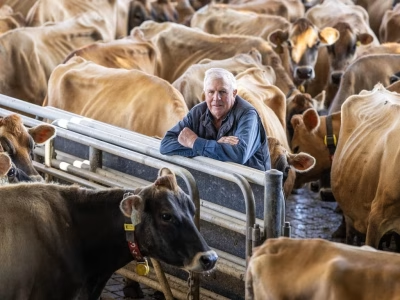
Robert Brokenshire spent more than two decades juggling life as a dairy farmer with that as a parliamentarian, before leaving politics in 2018. Picture: Kelly Barnes.
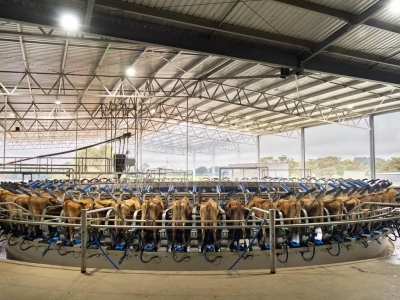
The milking stations at Robert Brokenshire’s dairy farm. Picture: Tim Joy
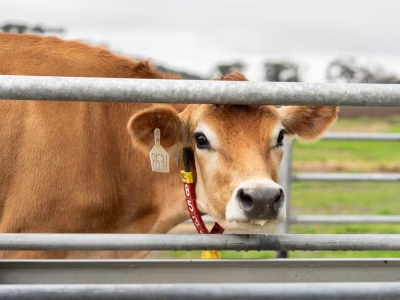
To Bernard ‘BJ’ Watson, jersey cows are just like three or four year olds. Picture: Tim Joy
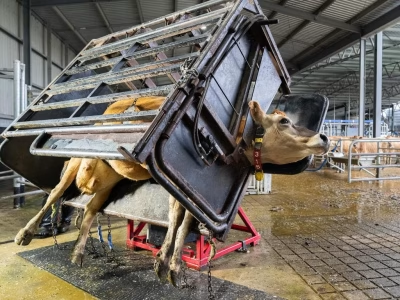
The specialised machine which allows for head milker Bernard Watson to give the cows some hooves maintenance. Picture: Tim Joy
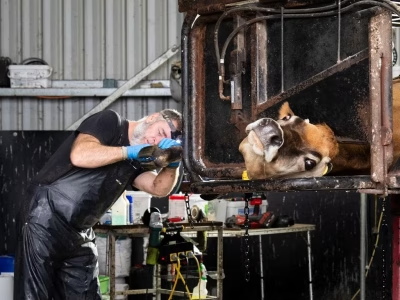
Head milker Bernard Watson giving a cow some hooves maintenance. Picture: Tim Joy
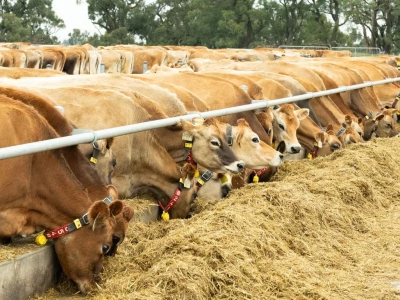
Cows feeding after their milking at Robert Brokenshire’s dairy farm at Mount Compass. Picture: Tim Joy
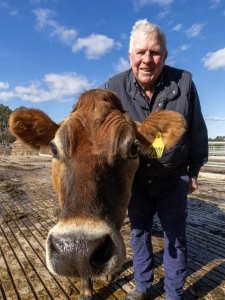
Mr Brokenshire says any death of a cow, calf or heifer leaves a mental toll. Picture: Tim Joy